When most people first hear about crypto, they think of Bitcoin or Ethereum — and then quickly get lost when they realize there are thousands of others out there.
But not all cryptos are the same. Some are coins, others are tokens, and knowing the difference is one of the most important steps in understanding the crypto world.
Let’s break it down in the simplest way possible
Coins: The OGs of Crypto
Coins are digital currencies that run on their own blockchain — their own independent system.
Think of a blockchain as a country, and a coin as that country’s currency.
For example:
- Bitcoin (BTC) runs on the Bitcoin blockchain
- Ether (ETH) runs on the Ethereum blockchain
- BNB runs on the BNB Smart Chain
These coins are like the backbone of their respective networks. They’re used to:
- Pay transaction fees
- Transfer value between users
- Store value (like savings)
Everyday example:
Imagine you’re traveling to the U.S. — you’ll need U.S. dollars to move around, right?
That’s how coins work. If you’re using the Bitcoin network, you’ll need Bitcoin. If you’re using Ethereum, you’ll need Ether.
Each coin belongs to — and powers — its own blockchain economy.
Tokens: The Guests in the House
Tokens, on the other hand, don’t have their own blockchain.
They live on top of another blockchain and borrow its technology.
For example:
- USDT (Tether) can exist on Ethereum (ERC-20), Tron (TRC-20), or BNB Smart Chain (BEP-20)
- APE (ApeCoin) and UNI (Uniswap) both run on Ethereum’s blockchain
So, while coins are like owning the land, tokens are like building your house on someone else’s property.
You’re using their foundation to run your own project.
Why Tokens Exist
Tokens make it easy for developers to create new projects without building a blockchain from scratch.
Imagine if every mobile app had to build its own phone just to work — it’d be chaos.
Instead, apps use existing platforms (like Android or iOS).
In crypto, tokens work the same way — they’re apps built on blockchains.
Tokens can represent all sorts of things:
- Money (like USDT, a stablecoin)
- Ownership (like UNI, a governance token)
- Game rewards (like AXS, from Axie Infinity)
- NFTs (unique tokens that represent art or collectibles)
Coin vs. Token: The Quick Comparison
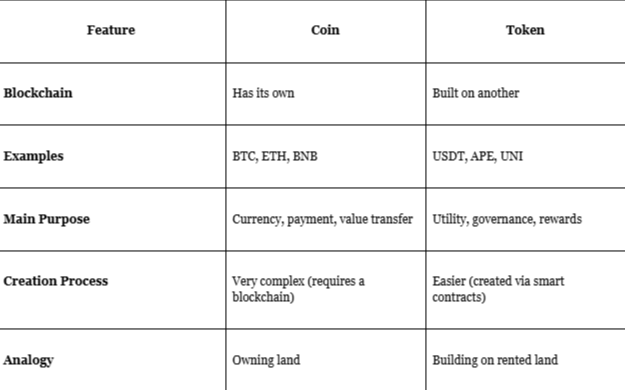
Why This Matters for You
Understanding this difference helps you make smarter choices:
- When you’re sending or receiving crypto, you’ll know which network to use (important for avoiding lost funds).
- When you’re investing, you’ll know whether you’re supporting a full blockchain ecosystem (coin) or an app built on one (token).
- When you’re learning through HARA, you’ll be able to identify what kind of crypto you’re dealing with before taking any step.
Real-Life Scenario
Let’s say Chidi wants to send ₦50,000 worth of USDT to his cousin in Ghana.
He opens his HARA wallet and sees multiple USDT options — TRC-20, ERC-20, and BEP-20.
Here’s what’s happening:
- USDT is a token, not a coin.
- It can exist on different blockchains (Tron, Ethereum, or Binance Smart Chain).
- Each blockchain has its own fee and speed.
So, choosing TRC-20 (Tron) means faster delivery and lower fees.
That simple understanding can save users money, time, and confusion.
How HARA Makes It Simple
HARA helps you:
- Easily identify which network your token is on
- Send or receive coins and tokens safely
- Learn about the difference while using the app
No technical jargon — just simple steps, practical tools, and guides built for everyday users.
Key Takeaway
Coins and tokens are like siblings in the same crypto family — similar, but not the same.
- Coins = the foundation (they power blockchains).
- Tokens = innovation (they build exciting things on top).
Understanding this difference is your first step from being crypto curious to crypto confident.