When people hear the word crypto, they often think of flashy investments, profits, or “moon shots.”
But behind every transaction, NFT, and blockchain app, there’s something quietly making it all run smoothly: utility tokens.
They may not always make headlines, but without them, the entire crypto world would grind to a halt.
Let’s unpack what utility tokens are, how they work, and why they matter to you.
What Are Utility Tokens?
A utility token is a type of cryptocurrency that gives you access to a product, service, or function inside a blockchain ecosystem.
Think of it as fuel, airtime, or a ticket that lets you do something within that network.
Just like you buy airtime to make calls or data to browse, you need utility tokens to make things happen on a blockchain — like sending crypto, minting NFTs, or interacting with a DeFi app.
Everyday Analogy: The Airtime of Crypto
Let’s say you use MTN.
- You can’t make a call or send a text without airtime.
- Even though airtime itself isn’t money, it powers your access to communication.
Utility tokens work exactly the same way.
They aren’t just for holding — they let you do things.
Examples of Popular Utility Tokens
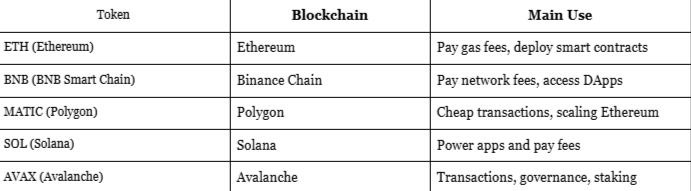
Whenever you perform an action on these networks — whether you’re sending crypto, buying an NFT, or staking coins — these tokens are what make it possible.
Why Are They Called “Utility” Tokens?
Because they’re useful.
Unlike meme coins or speculative assets, utility tokens serve a real purpose in their ecosystems.
They’re like the oil that keeps an engine running smoothly — invisible most of the time, but essential for everything else to work.
How You Use Utility Tokens Every Day (Without Realizing It)
Even if you’re new to crypto, you’ve likely already interacted with utility tokens.
- When you swap crypto on an exchange, you’re paying a small fee in that blockchain’s utility token.
- When you send USDT (on Ethereum), you pay the fee in ETH.
- When you use BNB Smart Chain, your fee comes out in BNB.
So, even if your main focus is a stablecoin like USDT, you’ll still need utility tokens behind the scenes — they’re what make your transactions possible.
Real-Life Example
Let’s say Ada wants to send ₦20,000 worth of USDT to her friend.
She’s using the BNB Smart Chain (BEP-20) network.
To complete the transfer, she’ll need a small amount of BNB (the network’s utility token) to pay the fee ; usually less than ₦200.
Without BNB in her wallet, the transaction won’t go through.
That’s how essential utility tokens are.
Why Beginners Should Care About Utility Tokens
- They make your transactions possible; no utility token = no movement.
- They affect transaction cost; networks with cheaper utility tokens (like TRON or Polygon) help you save money.
- They show real blockchain adoption; the more people use a network, the more demand for its utility token grows.
For example:
- If a lot of people use Ethereum-based apps, demand for ETH rises.
- If new DeFi apps launch on Polygon, MATIC becomes more valuable.
How HARA Helps Simplify This
HARA was built for beginners, so you don’t have to stress about complex token mechanics.
Through the platform, you can:
- See which network your token runs on.
- Instantly know if you need a utility token to make a transaction.
- Access learning guides (like this series!) that help you understand what’s happening behind the scenes.
Our goal is simple: to make crypto usable, understandable, and accessible to everyone.
Key Takeaway
- Utility tokens are the lifeblood of blockchain networks.
They’re what make everything else possible — payments, apps, NFTs, DeFi, you name it. - If coins are the foundations of crypto, then utility tokens are the energy that keeps everything running.