If you have checked your portfolio in the last two weeks and felt your heart drop, hold my hand; you are not alone. The market is down. Significantly. And the noise around it makes it even harder to think clearly.
So let us think together.
Here is what is actually happening in the crypto market right now, why it matters specifically for Nigerian traders, and what experts are doing while everyone else is reacting.
The Data: What is Happening Right Now?
After reaching a strong local high of approximately $83,800 in early May 2026, Bitcoin broke below its key support levels, tumbling down to the $62,000 – $63,000 range. This sharp drop has altered short-term market dynamics across the board.
To understand the scale of this shift, look at the core market metrics from the first week of June 2026:
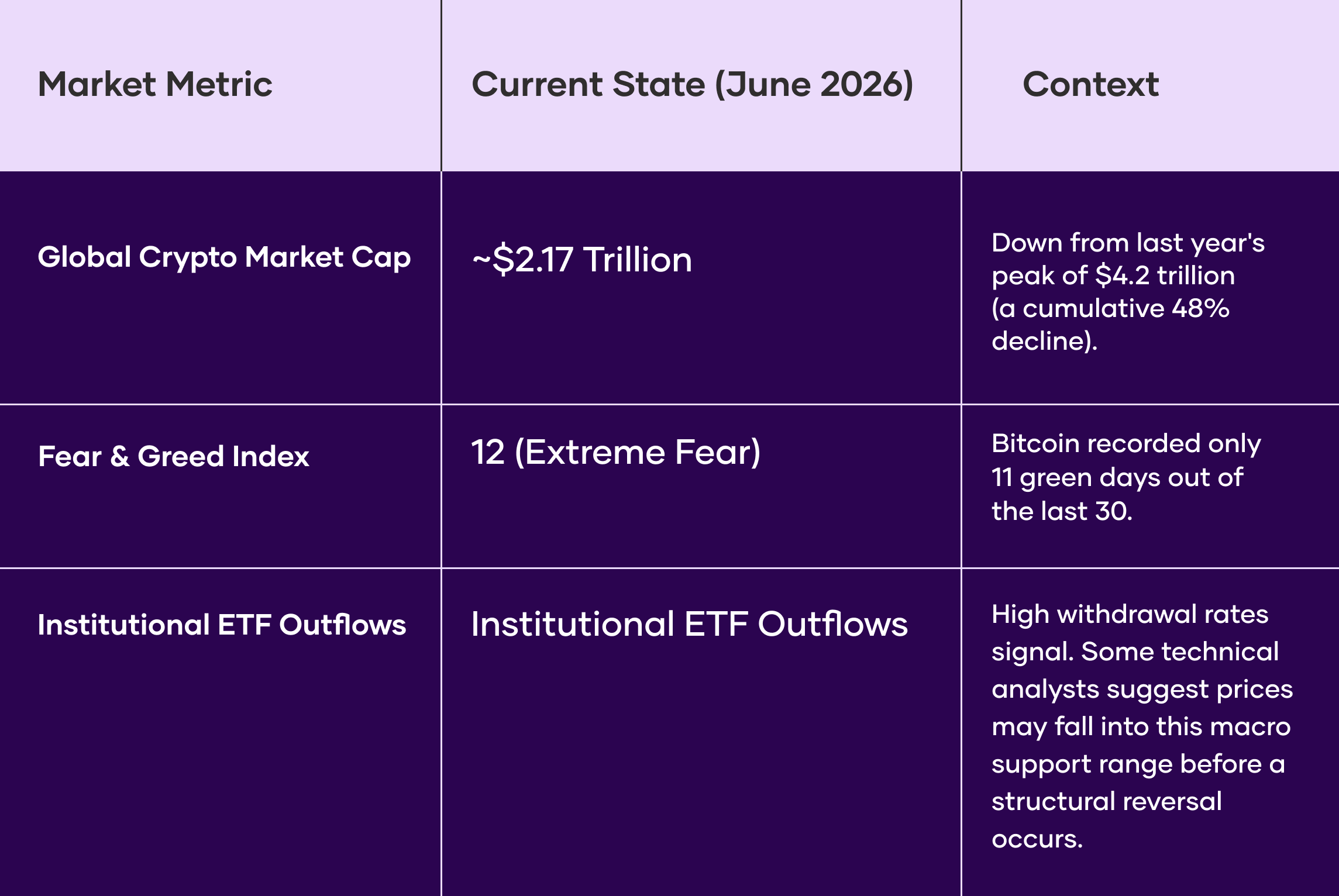
The 3 Core Causes of the June 2026 Market Correction
This downturn is driven by a clear combination of international politics, institutional portfolio restructuring, and macroeconomic pressures.
1. Geopolitical Tension and the Energy Squeeze
The primary trigger started outside of the crypto space. Escalating US-Iran tensions have directly threatened the Strait of Hormuz, a trade corridor that handles roughly 20% of the world’s daily oil supply. This friction caused global energy prices to spike, fueling intense inflation fears. When inflation risks increase, institutional capital quickly moves out of speculative assets like cryptocurrency and shifts into safer, traditional options.
2. The Great AI and Tech Stock Rotation
Crypto is currently facing massive competition for investor liquidity. With the booming expansion of artificial intelligence and high-profile private equity developments such as tokenized equity initiatives and upcoming aerospace listings; institutional managers are actively taking profits from crypto and reallocating that cash into traditional US tech sectors. This rotation has led to over $4 billion in net outflows from US spot Bitcoin ETFs since mid-May.
3. Living Costs and Retail Liquidation
Sticky global inflation means central banks are delaying highly anticipated interest rate cuts. For everyday professionals and retail traders, this translates to a severe cost-of-living squeeze.
On-chain data indicates that long-term asset holders are not panic-selling due to a loss of faith in blockchain technology. Instead, everyday people are liquidating their holdings simply because they need immediate cash to cover rising household expenses, fuel, and daily operational costs.
What Are Analysts Actually Saying?
While short-term price action remains highly volatile, institutional firms and long-term market analysts are not treating this correction as permanent market weakness.
- Six-Figure Projections Remain Intact: Major institutional players like Bernstein, Standard Chartered, and Nexo continue to cite institutional adoption and post-halving cycle normalization as core structural pillars. Consensus forecasts for late 2026 still cluster in the $120,000 to $175,000 range, with broader analyst bands stretching up to $225,000.
- An Accumulation Phase, Not a Crash: Leading financial desks describe the current price movement as a healthy consolidation and accumulation phase. Bitcoin remains range-bound between broader long-term metrics, and strong institutional demand is expected to step in heavily below current price points.
The Takeaway: The analysts who have successfully navigated previous market cycles are not calling this the end of the road. They view it as a painful, geopolitically driven, macro-pressured dip that the ecosystem will eventually price through.
Two Costly Mistakes to Avoid Right Now
Mistake 1: Panic Selling at the Bottom
If you sell your digital assets solely out of fear, you are locking in paper losses at the worst possible price point. Geopolitically driven market corrections are historically sharp but temporary. If your original reason for investing hasn't changed, selling in a panic usually leads to regret when the market inevitably stabilizes.
Mistake 2: Going "All-In" to Catch the Dip
The opposite of panic selling is aggressive, emotional buying. While prices are low, nobody can predict the exact bottom. Some technical analysts suggest Bitcoin could test lower support bands between $50,000 and $53,000 before a structural reversal occurs. Risking capital you need for immediate survival is a dangerous gamble.
What is the Most Practical Financial Move This Month?
- Hold Firm (If Your Capital is Secure): If you do not need your investment money for immediate bills, staying the course is a historically sound strategy. Every single time the Crypto Fear & Greed Index has hit Extreme Fear, it has eventually been followed by a long-term recovery.
- Prioritize Stability via Stablecoins: If you want to protect your purchasing power from daily price drops without completely exiting the ecosystem, convert your volatile assets into Stablecoins like USDT. This tethers your value to the US Dollar, shielding your capital from market swings.
- Automate Your Liquidations: Save yourself the stress of monitoring charts 24/7 and waiting around for transaction confirmations. Use Hara AutoSell to completely bypass the hassle. The system will instantly convert any incoming crypto deposits directly into Naira (NGN) the second it hits your wallet.
Frequently Asked Questions (FAQ)
1. Why did Bitcoin drop so much in June 2026?
The crash was caused by a combination of escalating geopolitical conflicts affecting global energy supply lanes, continuous institutional outflows from US spot ETFs, and a massive capital rotation into high-performing traditional AI and tech stocks.
2. Should I sell my crypto now or hold?
This depends entirely on your personal cash flow. If you require immediate funds to handle local expenses or business costs, liquidating is a practical necessity. If you do not need the cash immediately, historical patterns suggest that selling during periods of "Extreme Fear" generally results in missed recovery gains.
3. Can I trade safely during a market panic?
Avoid informal peer-to-peer (P2P) grey markets. During deep market corrections, irregular third-party bank transfers spike significantly, leading to a massive increase in bank account freezes and Post No Debit (PND) orders in Nigeria. Use a secure, automated exchange platform like Hara to ensure your cash-outs are settled safely and instantly.
4. What is AutoSell on Hara and how does it work?
AutoSell is a Hara feature designed to protect you from sudden market drops by removing the manual work from trading. Instead of opening the app to initiate a trade and waiting for blockchain confirmations, AutoSell automatically processes incoming crypto deposits and instantly converts them straight to Naira (NGN) the moment they land.
5. Is now a good time to buy crypto in Nigeria?
Historically, periods of Extreme Fear have been associated with favourable long-term entry points. However, nobody can predict where the price will go in the short term. If you are considering buying, small, consistent amounts over time is generally considered a more disciplined strategy than attempting to buy in large volume.
Ready to trade smarter in a volatile market? Set up AutoSell on Hara or buy at the best available rates — all from one platform. Download the Hara app