If you've followed crypto for a while, you've probably seen Bitcoin and other cryptocurrencies rise sharply one week and drop the next.
Interestingly, not every cryptocurrency is designed to behave that way.
USDC, also known as USD Coin, is a stablecoin designed to maintain a value equivalent to one US dollar. It's issued by Circle and backed by reserves of cash and cash-equivalent assets.
So, what makes that possible? And why would someone choose a stablecoin over another cryptocurrency? To understand that, let's start with the basics.
What Is a Stablecoin?
A stablecoin is a type of cryptocurrency designed to maintain a relatively stable value by linking it to another asset, such as the US dollar or gold.
There are different types of stablecoins, depending on how they try to maintain that value. Some are backed by reserves of traditional assets, while others use cryptocurrency collateral or algorithmic mechanisms.
USDC is a fiat-backed stablecoin. Its reserves consist of cash and cash-equivalent assets intended to support its value and redemption at one US dollar per USDC.
That doesn't mean its market price can never move away from $1. It means the asset is designed to maintain that value, rather than rely on market demand alone to determine its target price.
How Does USDC Work?
USDC operates on supported blockchain networks, allowing people to hold and transfer it through compatible wallets and platforms.
Its value-stability model is different from that of cryptocurrencies such as Bitcoin and SOL.
Circle holds reserves intended to back the USDC in circulation. For example, 100 USDC is designed to represent approximately $100 in value.
However, the price you see on a trading platform may differ slightly from $1. Market conditions, liquidity, fees, and the platform you're using can affect the amount you pay or receive.
How Is USDC Different From Other Cryptocurrencies?
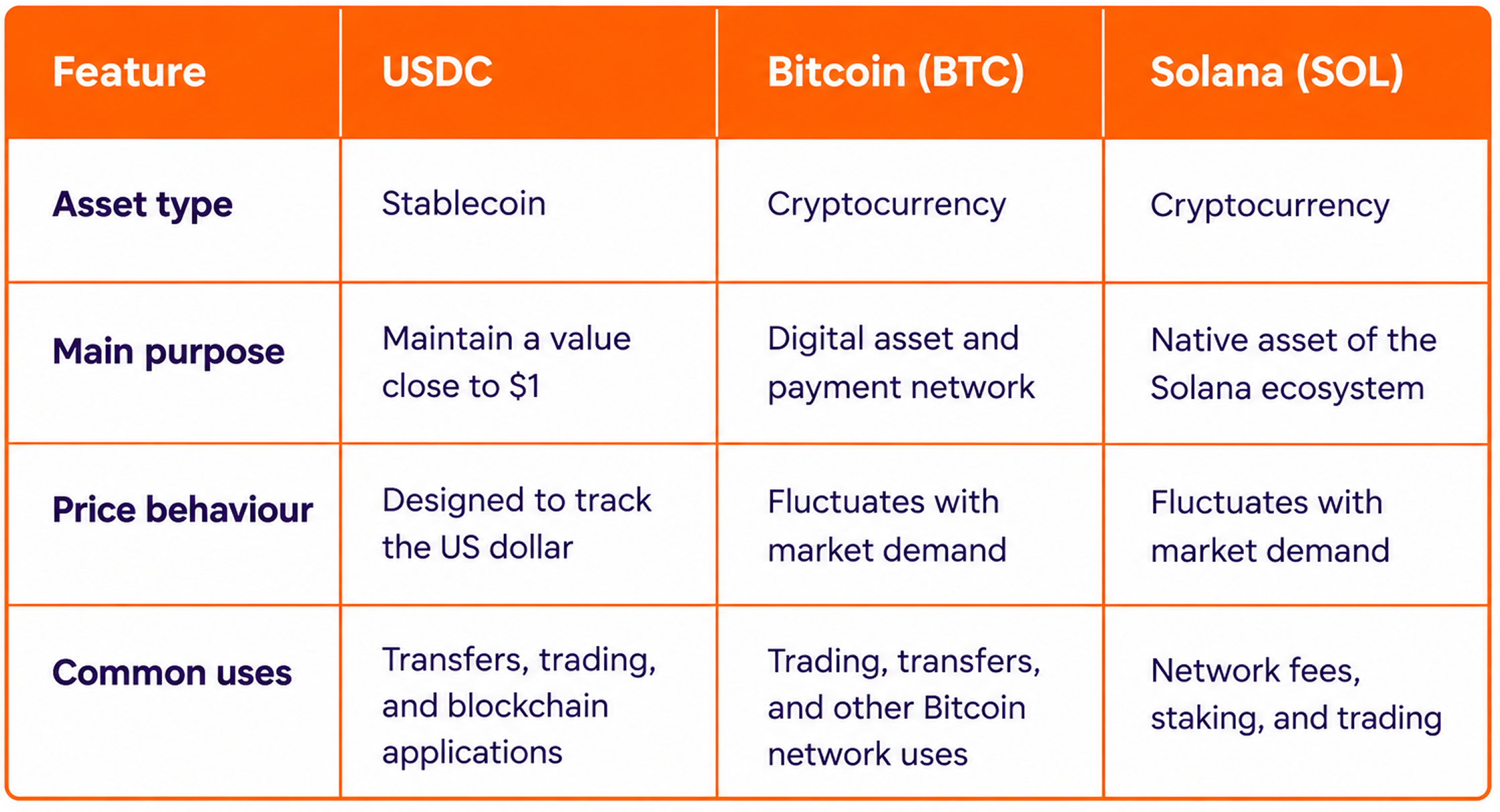
These assets serve different purposes. None is automatically the right choice for every user or every trading situation.
1. USDC is designed for price stability
Bitcoin and SOL can experience significant price changes over short periods. USDC is designed to behave differently by maintaining a value close to the US dollar. This can make it useful for people who want to hold dollar-denominated value within the crypto ecosystem.
Still, stability is the goal, not an absolute guarantee. USDC can temporarily trade above or below $1.
2. USDC can help traders move between crypto assets
Imagine you've sold some SOL and want to keep the proceeds in a dollar-pegged digital asset while deciding what to do next. If your trading platform supports the relevant transactions, you could exchange SOL for USDC instead of immediately selling into another currency.
This gives you a different way to manage your crypto holdings. It doesn't eliminate risk, and USDC's value relative to the Naira can still change as the USD/NGN exchange rate moves.
3. USDC has different risks
USDC's price-stability design doesn't make it risk-free.
Its risks include the possibility of a temporary loss of its dollar peg, issues affecting its issuer or reserves, platform failures, and problems involving blockchain networks or wallets.
Bitcoin and SOL have different risk profiles, including greater exposure to market-price fluctuations. Understanding these differences can help you decide what role, if any, each asset should play in your trading activities.
What Can You Use USDC For?
USDC has several uses beyond simply holding a digital asset designed to track the dollar.
Trading
Some crypto platforms offer trading pairs involving USDC. This allows users to exchange supported cryptocurrencies for USDC and vice versa. Availability depends on the platform and its supported trading pairs.
Sending and receiving digital dollars
USDC can be transferred between compatible blockchain wallets. Transactions may be processed outside traditional banking hours, although confirmation times and network fees depend on the blockchain being used. Always confirm that the receiving wallet supports the exact network you're sending USDC on.
Cross-border transfers
People and businesses can use USDC to transfer dollar-denominated value across borders through compatible platforms and wallets. However, recipients may need to convert it into local currency, and fees, exchange rates, and local platform availability can affect the final amount received.
Blockchain applications
USDC is supported by various decentralised finance applications and other blockchain-based services. Depending on the service, users may be able to use it for lending, borrowing, providing liquidity, or other activities. These services can carry additional risks. Simply holding USDC does not automatically earn interest or generate rewards.
Is USDC the Same as Holding US Dollars?
No. USDC is designed to maintain a value equivalent to one US dollar, but it isn't the same as cash or money in a bank account.
US dollars can be held in cash or in a bank account and transferred through traditional payment systems. USDC exists as a digital asset on supported blockchain networks.
When using USDC, you may need a compatible wallet or platform. You also need to consider network fees, platform charges, and the possibility that the market price could temporarily deviate from $1.
The distinction matters because a dollar-pegged cryptocurrency still carries risks that aren't identical to those of holding traditional dollars.
What Should You Know Before Trading USDC?
Before buying or selling USDC, keep these points in mind.
- Check the rate. USDC aims to maintain a value close to $1, but the rate offered by a platform may vary.
- Understand the fees. Trading fees, network fees, and conversion costs can affect the amount you receive.
- Check network compatibility. USDC exists on multiple blockchain networks. Confirm the supported network before making a transfer.
- Understand the risks. A stablecoin can still face market, issuer, platform, and technical risks.
- Consider your purpose. Whether you're trading, transferring funds, or using a blockchain application, make sure the asset and service fit what you need to do.
A stablecoin isn't a shortcut to guaranteed profits. Its primary distinction is the way it is designed to maintain its value.
How to Buy and Sell USDC on Hara
USDC is now available on Hara alongside other supported cryptocurrencies.
If you'd like to trade it, open your Hara app, navigate to the crypto trading section, and select USDC. Choose whether you want to buy or sell, then review the displayed rate and transaction details before confirming.
Always check the information shown in your app before completing a trade.
Whether you're exploring stablecoins for the first time or adding another asset to the cryptocurrencies you already trade, understanding how USDC differs from other crypto assets is a useful place to start.
Frequently Asked Questions About USDC
What does USDC stand for?
USDC is commonly known as USD Coin. It is a stablecoin issued by Circle and designed to maintain a value equivalent to one US dollar.
Is USDC a cryptocurrency?
Yes. USDC is a cryptocurrency known as a stablecoin. It operates on supported blockchain networks and is designed to maintain a value close to the US dollar.
Is USDC always worth $1?
USDC is designed to maintain a one-to-one value with the US dollar, but its market price can temporarily move above or below $1. The price you receive may also depend on the platform and any applicable fees.
What is the difference between USDC and Bitcoin?
USDC is a stablecoin designed to track the US dollar, while Bitcoin is a cryptocurrency whose market price fluctuates with supply, demand, and market conditions. They serve different purposes and carry different risks.
What is the difference between USDC and USDT?
USDC and USDT are separate stablecoins issued by different organisations. Both aim to maintain a value close to one US dollar, but they have different issuers and reserve arrangements.
Can I trade USDC in Nigeria?
You can trade USDC through platforms that support the asset and serve Nigerian users. Hara supports buying and selling USDC through its app.
Is USDC risk-free?
No. Although USDC is designed to maintain a stable value, it can temporarily lose its dollar peg. Users may also face issuer, platform, network, and wallet-related risks.
Understanding Stablecoins Starts With Understanding Their Purpose
USDC offers a different way to participate in the crypto ecosystem. While Bitcoin and SOL have market prices that fluctuate more freely, USDC is designed to maintain a value close to one US dollar.
That difference can make it useful for trading, transfers, and blockchain applications, depending on your needs.
The important thing is to understand what you're trading, how the asset works, and what risks come with using it.
Learn the difference. Check the rate. Make your move with Hara. 💜